
Collier Neighbors Across Official Sources
No single Collier County roll names every person on a block. Each official source answers a narrower question. Parcel geometry defines the nearby land, the appraiser names owners, requested voter data lists nonexempt registered voters, and permits describe events tied to an address. Public association pages may identify officers or managers, but a private roster is not an official directory.
| Source | What It Shows About a Block | Access |
|---|---|---|
| Parcel GIS | Shapes, shared boundaries, situs, detail links | Free map, pan and click |
| Property Appraiser roll | Owners and tax mailing addresses | Free parcel portal |
| Voter extract | Nonexempt registered voters by residence | Public-record request or state disk |
| Permits and code | Address events, applicants, contractors | Correct county or city portal |
| Association contacts | Boundaries and public officers or managers | Public contact only |
Ownership is not occupancy. The owner may live elsewhere, and a renter or family member may never appear on the property card. Record only what a source establishes, preserve the date checked, and expect lawful omissions.
Map Collier Neighbors Parcel by Parcel
Start at the Collier County Property Appraiser. Search the physical, or situs, address and save its folio. Open the parcel map, zoom until lot lines appear, then click every parcel sharing a boundary plus the lots directly across the road. Visible geometry works better than sequential street numbers on curves, large estates, and gated roads.
- Resolve the target address to its exact folio and legal description.
- Open the GIS view and click each shared-boundary polygon.
- Add parcels directly across the street, using pan and identify tools when available.
- Confirm each folio in the appraiser roll and record owner and situs separately.
- Move to requested voter data or permits only when those sources answer a remaining question.
For a full named-street chain, use the Collier County street directory. A neighbor lookup stays focused on the immediate block and community layer.
Block flow: one situs address → folio → touching parcels → appraiser owner records → limited resident and community evidence.
Radius Search Changes Collier Results
Collier's appraiser offers an unusual Radius tab. It requires a subject parcel ID and accepts a distance from 100 through 1,000 feet. The system measures outward from the parcel edge, counts parcels touching the buffer, and excludes the subject parcel itself. This is not the same as drawing a circle from a street point.
That design is useful for acreage in Golden Gate Estates or irregular development patterns. It can be less intuitive in a condominium. Many units may share one mapped parcel, so a radius result can return a large set of owners while the system cannot measure distances between units inside the same polygon. Use Sub/Condo and unit searches to interpret those results.
A mapped buffer is optional. Clicking the shared boundaries remains the clearest method when the task is to identify immediate Collier County neighbors rather than everyone within a broad distance.
Separate Collier Owners From Occupants
The appraiser record separates situs from owner mailing address. Situs is the parcel's physical location. Mailing address is where tax notices go. They may match for an owner-occupied home, but a post office box, management office, seasonal address, or out-of-state destination does not identify who lives at the property.
Homestead status is another clue, not a household list. It may support owner occupancy, subject to legal timing and portability, but it cannot name a spouse, child, roommate, renter, or guest. The appraiser says ownership is typically current within one month of recording, which also leaves a short lag after a transfer.
- Folio
- Collier County's identifier for one property record.
- Situs address
- The physical site of the parcel.
- Mailing address
- The destination for owner tax correspondence.
- Parcel
- A legally described unit of land, which may contain more than one residence.
Request Collier Neighbor Voter Data
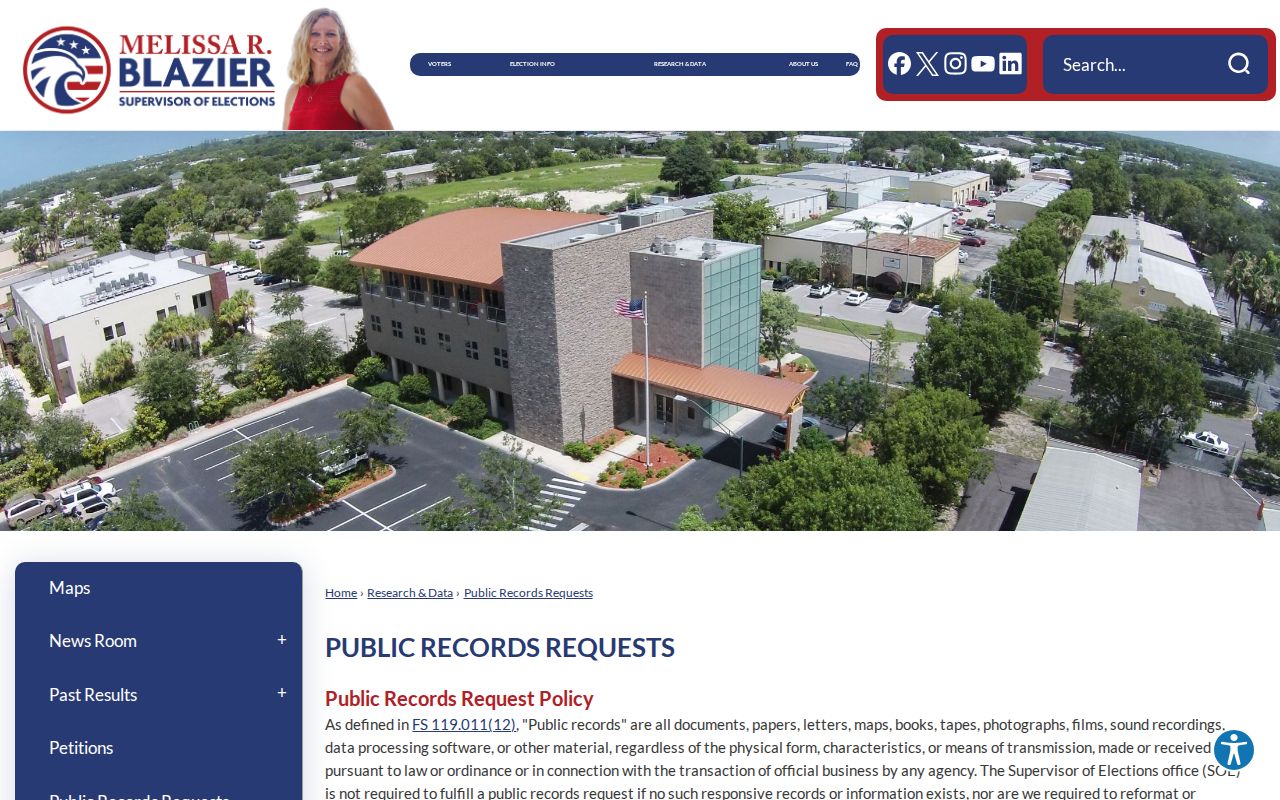
The public registration-status screen is an authenticated self-lookup. It asks for first name, last name, and date of birth matching a Florida driver license or state identification card. It is not a public street browser. Block research instead requires a released voter extract from the Collier Supervisor of Elections public-records process.
Requests can go through NextRequest, email, phone, mail, or in person. Electronic delivery is preferred. The county voter list carries a $10 service fee. Maps cost $25; the first ten paper pages are free, later pages cost $0.15 each, and certified pages cost $1. Research under fifteen minutes has no charge, while longer work uses the lowest qualified employee's hourly rate.
The request page is shown below.
A released file may include name, residence address, birth date, party, phone, and email when supplied. It omits preregistered minors, Address Confidentiality Program participants, and approved protected voters. Participation history says an election was credited, never how anyone voted.
Reach Collier Elections by Several Channels
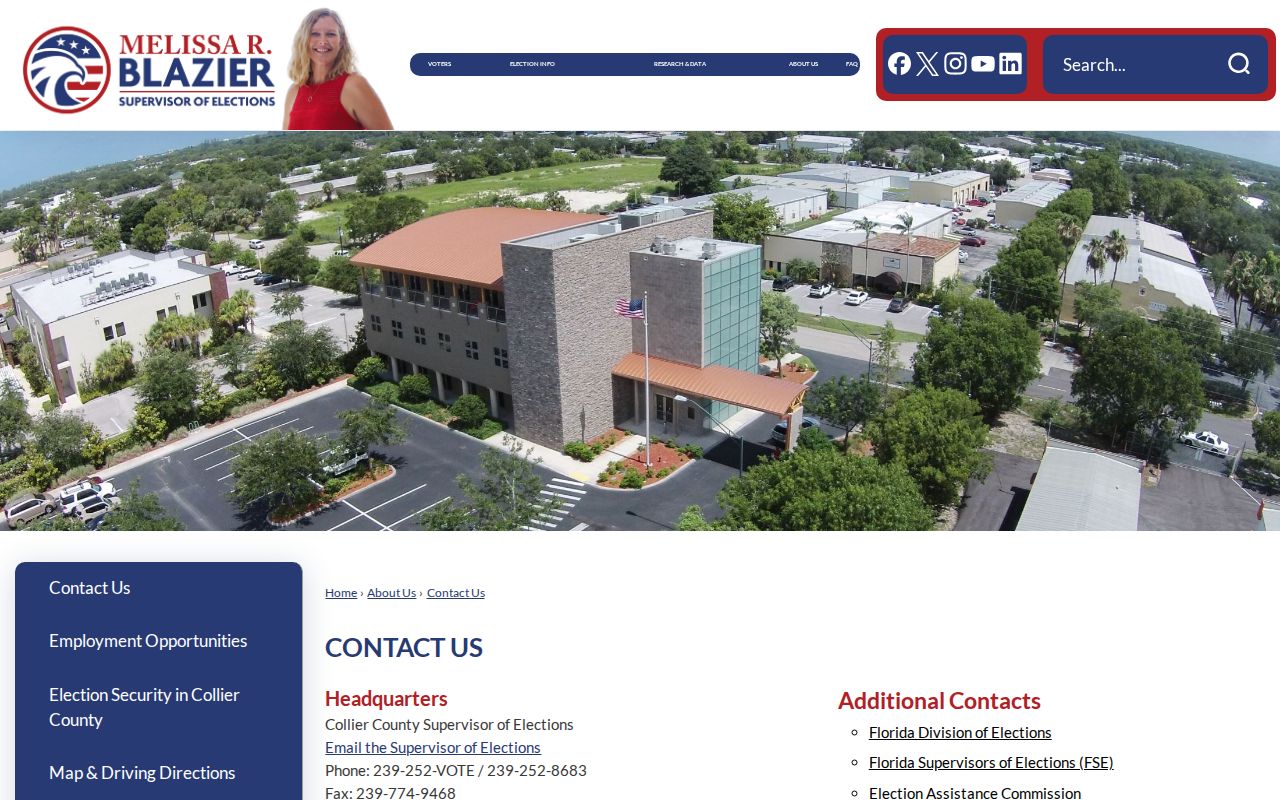
The Collier Supervisor of Elections headquarters is at 3750 Enterprise Avenue, Naples, with weekday hours from 8 a.m. to 5 p.m. Phone requests use 239-252-8683. Listed satellite offices at 2335 Orange Blossom Drive and 15450 Collier Boulevard operate weekdays from 9 a.m. to 6 p.m. Mail and in-person service remain available when the online request route is unsuitable.
The official Elections contact page is shown below.
Ask for fields needed for a lawful block-level task, not the broadest possible file. Request contact information itself remains public for up to one year, and a request can close after thirty days if a needed clarification receives no response.
Collier Community Contacts Are Not Rosters
Collier County has master-planned communities, condominium associations, and neighborhood groups, yet research found no authoritative countywide public membership directory. A government advisory-board page or association site may establish a boundary, president, or manager. It does not make the member list public. Congregation lists, watch-group rolls, utility customers, delivery records, renters, and household members also sit outside an official block lookup.
Property Appraiser
Use the official parcel search for folios, situs, owners, mailing destinations, and links to GIS.
Supervisor of Elections
Request releasable voter data by online system, email, phone, mail, or at an office.
Collier County Museums
Use the site tied to Naples, Everglades, Immokalee, Marco Island, or countywide history for local context.
Naples Historical Society archives contain oral histories, photos, newspapers, postcards, memoirs, and ephemera, but digitization is incomplete. Such collections can explain an old neighborhood name. They do not establish the current people on the block.
Check Collier Block Events by Address
The county's CityView portal offers public property, permit, and code-complaint searches from 2011 forward. A result may expose the folio, project site address, owner contact, subdivision, work type, contractor, declared value, inspections, and status. It can show construction patterns around a block.
Applicant and contractor names do not prove residence. Jurisdiction also matters. A Naples mailing address may sit outside the incorporated city, so resolve the parcel before deciding which office keeps the file. Marco Island and Everglades City are separate municipalities too.
Permit evidence works best as a dated event layer. It can confirm that a pool, addition, roof, or other work was recorded, but the appraiser remains the source for ownership and the voter extract remains a partial resident source.
Verify Collier Neighbors With Official Rolls
Commercial neighbor tools merge data from many dates and can confuse mailing addresses, past owners, relatives, and people with the same name. Official sources are narrower but name a custodian, display a date, and provide a correction or request path. Use commercial results, if encountered, only as leads and never as proof.
| Question | Official Record | Commercial Category |
|---|---|---|
| Who owns the parcel? | Current appraiser roll with folio | May lag or blend prior owners |
| Which parcels touch? | GIS geometry and legal parcels | May rely on street-number proximity |
| Which voters are released? | Dated Elections extract with exemptions | May omit source date and protected-record logic |
| How can an error be checked? | Contact the named custodian | Use the provider's correction or opt-out route |
Correct an official source with its custodian first. Florida's Digital Bill of Rights applies only to covered large controllers and does not erase an accurate deed or tax roll. A third-party removal request also cannot change the source record.
Protect Collier Neighbors From Record Scams
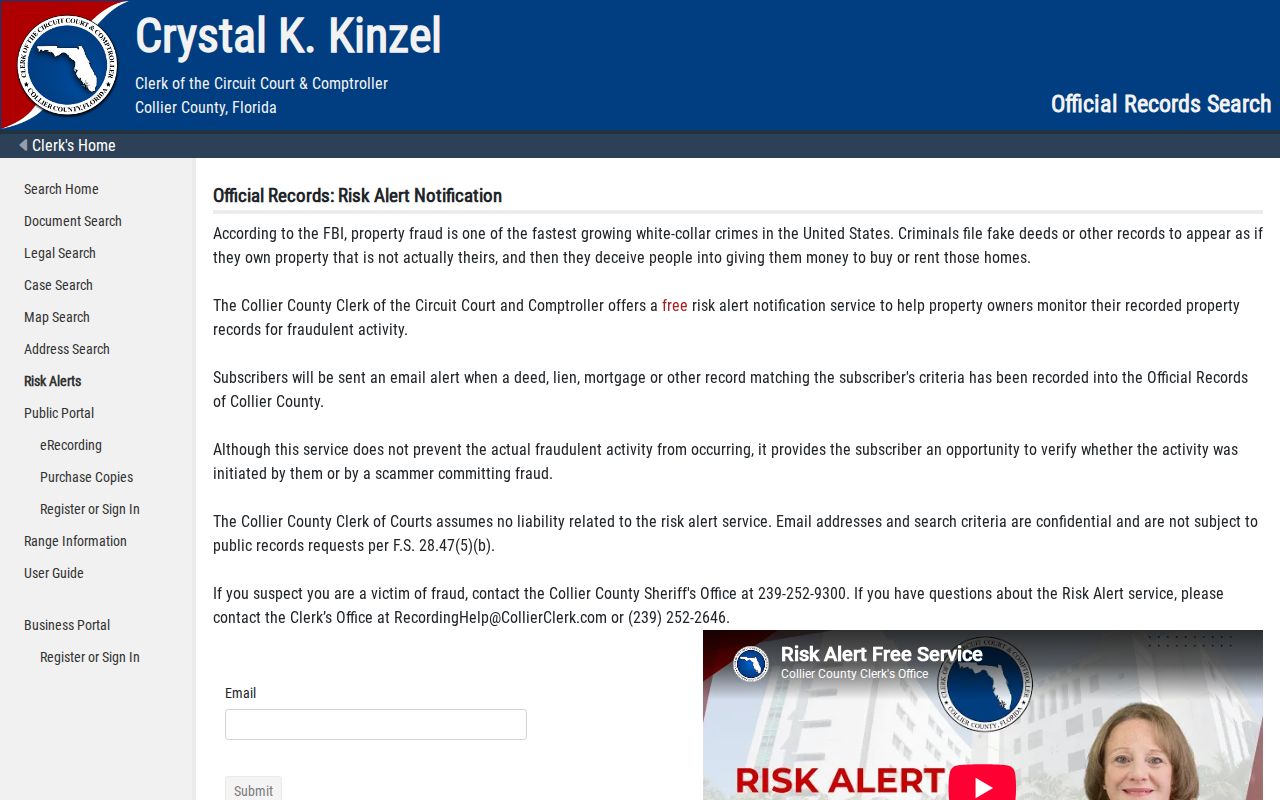
The Collier Clerk offers free Risk Alert enrollment for recorded property activity. It sends notice when a document is recorded under an enrolled personal or business name. The service does not stop filing or prove fraud, but it gives an owner a prompt to inspect the instrument and contact the Clerk or law enforcement.
The Collier Clerk Risk Alert page is shown below.
Share the official enrollment link with a concerned neighbor instead of circulating names or unverified accusations. If a scam involves payment demands or impersonation, preserve the message and use an official reporting channel.
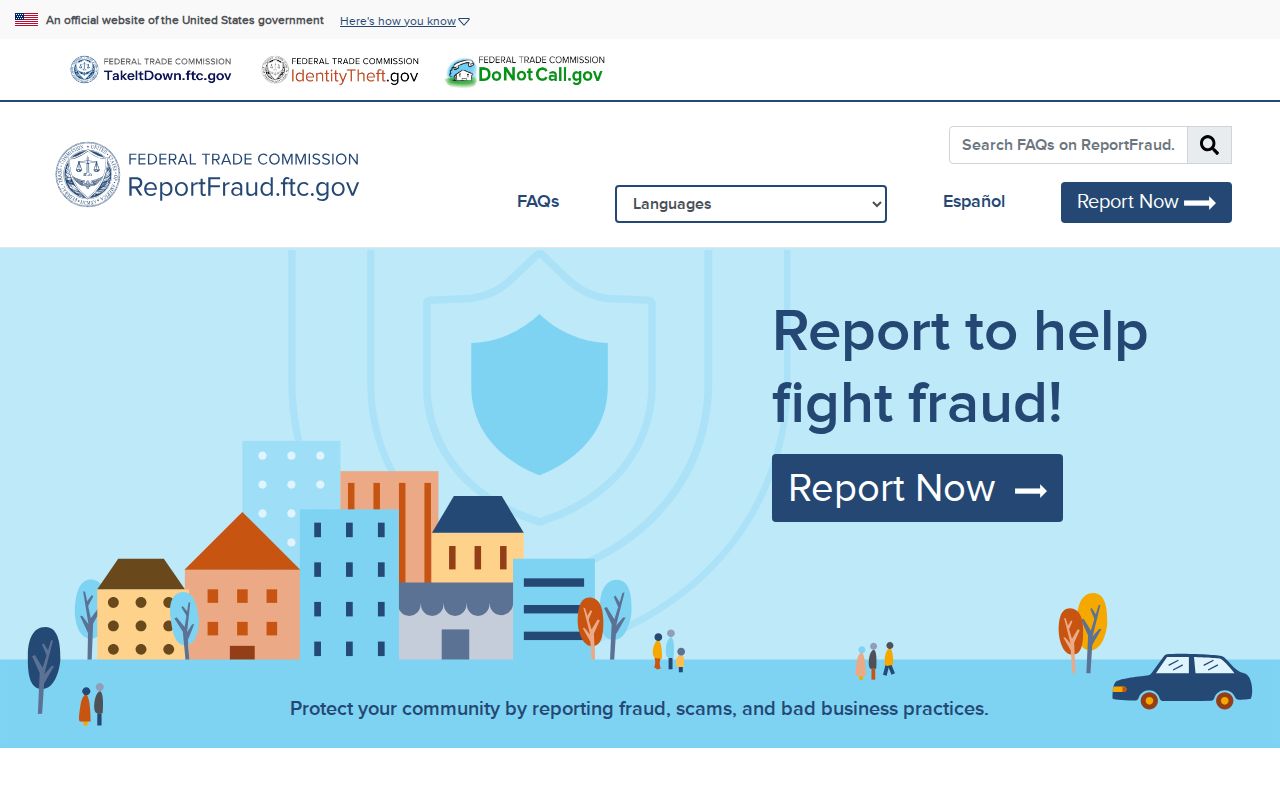
The Federal Trade Commission fraud-reporting portal accepts reports about scams and deceptive conduct.
For immediate danger call emergency services. A public record does not justify confronting a person or trying to investigate them in place of the proper agency.
Privacy Limits for Collier Neighbors
Expected gaps protect people and mark the limits of each roll. Florida's Address Confidentiality Program provides qualified domestic-violence victims a substitute address and mail forwarding. Separate exemptions under section 119.071 protect address or identifying data for specified high-risk personnel and victims. Voter data also withholds identification numbers, registration source information, preregistered minors, protected voters, and program participants.
Motor-vehicle addresses are restricted by federal law and are not a fallback. Utilities, delivery services, private rosters, and household lists are not public block directories. A broad chapter 119 request does not override these limits.
Lawful use. Use Collier County neighbor records for civic curiosity, a friendly introduction, property awareness, or safety. Never surveil, repeatedly contact, threaten, or harass anyone.
Florida law defines stalking, harassment, and cyberstalking, and public availability does not grant permission to misuse an address. Keep only the narrow data needed. When a record is redacted or absent, respect that boundary rather than searching for a way around it.